Brown butter brings a toasted, nutty note to whiskey. Rendered bacon fat gives bourbon a smoky edge. And a little virgin coconut oil can give rum the aroma of fresh coconut. All three use the same technique, known as fat washing.
The idea is simple. Let a flavorful fat mingle with a spirit, then chill the mixture until the fat firms up. Remove the fat and strain the spirit. Some of the aroma stays behind in the glass.
We’ll walk through the method using Sidewinder Rum and virgin coconut oil. Along the way, we’ll look at why a mixture of alcohol and water can pick up aromas from fat, and how perfumers in Grasse used the same affinity to capture the scent of fresh flowers.
From the Perfumer’s Bench
In Grasse, France, perfumers captured the scent of fresh jasmine by laying the blossoms on glass frames coated with a thin layer of fat. As the flowers gave up their fragrance, workers replaced them with fresh ones. After repeated rounds, the fat itself smelled of jasmine. This technique was called cold enfleurage, and the scented fat was known as a pomade.
Perfumers could use the pomade as it was or wash it with alcohol to draw out some of the fragrance. That second step has a close parallel at the bar. When we mix fragrant coconut oil with rum, some of the coconut’s aroma passes into the spirit. Chill the mixture, lift away the solid fat, and the rum still smells of coconut.
Historical source — Flowers and Extraction Methods
Coconut Oil–Washed Rum
Virgin coconut oil gives Sidewinder Rum the aroma of fresh coconut. Use an unrefined, non-deodorized oil with a distinct coconut scent. A small batch is enough to try in a Daiquiri and compare side by side with the original rum.
What You’ll Need
- 250 mL Sidewinder Rum
- 62.5 mL virgin coconut oil, measured once melted
- A wide-mouth freezer-safe jar with a lid, a fine-mesh strainer, and a coffee filter
The Method
- Melt the oil. Warm it gently just until liquid. Measure it, then let it cool until barely warm and still pourable.
- Infuse for two hours. Combine the rum and oil in the jar, close the lid, and swirl. Let it stand at room temperature for two hours.
- Freeze until the oil is firm. Set the jar upright in the freezer. Once the oil has formed a solid cap, lift it off or make an opening at the edge and pour off the rum.
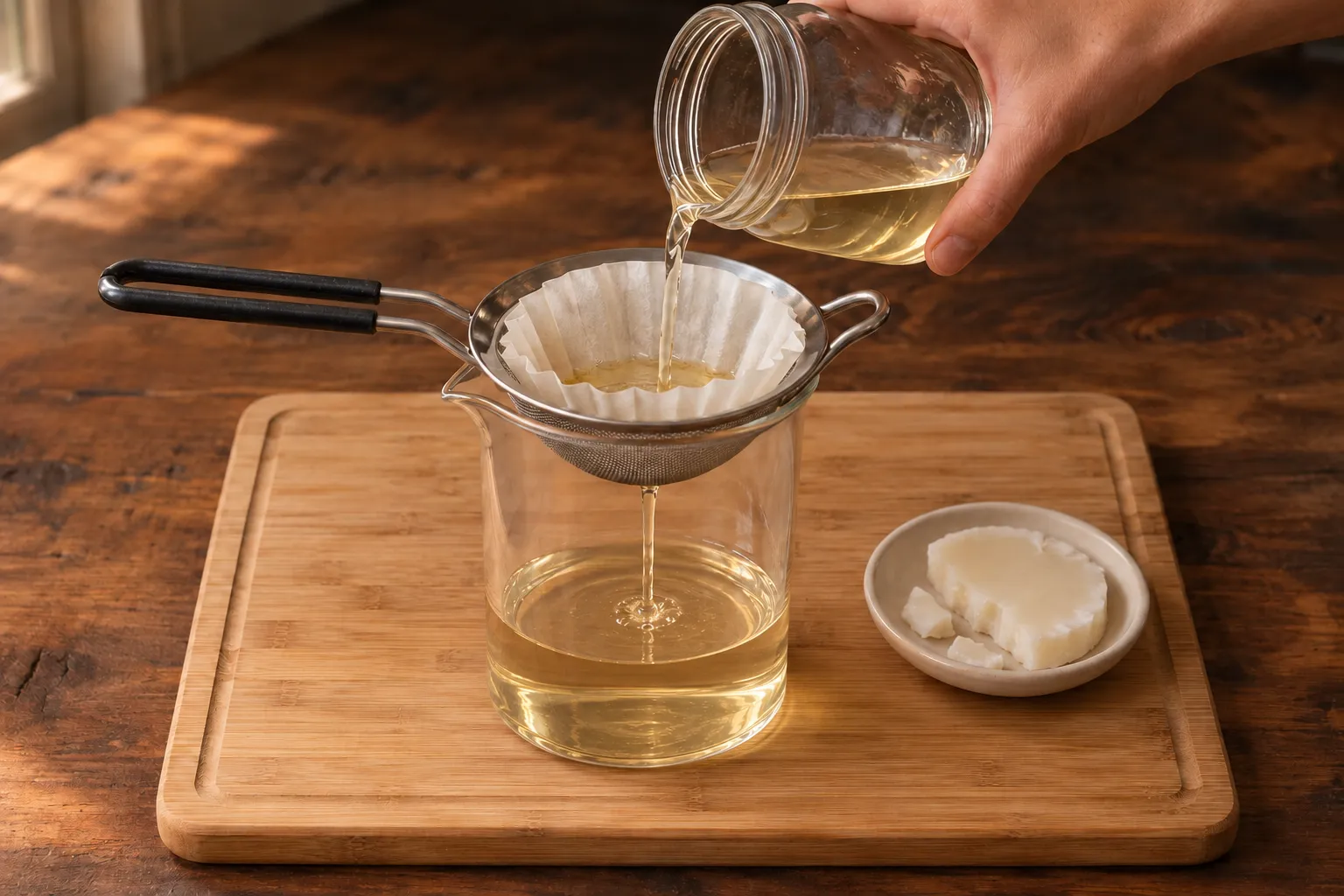
- Strain while cold. Pour the rum through a fine-mesh strainer lined with a coffee filter to catch any remaining flecks of solid oil. Bottle the strained rum.
Scaling the Batch
For this coconut rum, use one part melted coconut oil to four parts rum by volume. Divide the starting volume of rum by four to get the amount of oil. For 250 mL of rum, use 62.5 mL of oil. For a 750 mL bottle, use 187.5 mL. For 1 liter, use 250 mL.
For several bottles, divide the batch among wide-mouth freezer-safe containers of the same size, with room to swirl. Keep the two-hour infusion as your starting point and freeze until the oil cap is firm. Measure your yield after filtering. Some rum stays behind with the oil and in the filter, so starting with a 750 mL bottle will give you less than 750 mL of finished rum.
Choosing a Fat-to-Spirit Ratio
Start with the drink you want to make. In a Daiquiri, you might want enough coconut to come through the lime. In a maple Old Fashioned, a little smoke may be all you want from the bacon. For his Benton’s Old Fashioned, Don Lee uses 1½ ounces of rendered bacon fat for a 750 mL bottle of bourbon. Our coconut wash uses one part melted coconut oil to four parts rum by volume. Each is a starting point for the flavor you want in that particular drink.
How you bring the fat and spirit together matters, too. In his coconut oil and rum trials, Jean-Félix Desfossés found that stirring brought out more coconut flavor than letting the mixture sit. He also found that two smaller washes, using fresh oil each time, could yield a stronger coconut flavor than one larger wash.
To find what works for your drink, make two small batches and change one thing at a time. If you’re testing the ratio, vary the amount of fat and keep the spirit, infusion time, temperature, and stirring the same. If you’re testing stirring, use the same ratio in both batches. Taste the washed spirits side by side, then make the same cocktail with each. That’s where you’ll find out whether the coconut still comes through the lime or the smoke is where you want it against the maple.
Why This Method
The coconut oil and rum settle into separate layers, but some of the molecules that give the oil its aroma can move between them. Rum is a mixture of water and ethanol. Water is polar, and ethanol has a water-friendly end and a small nonpolar end. With ethanol in the mix, the rum can dissolve many aroma compounds that dissolve poorly in water alone.
Chemists call the way a compound distributes itself between two liquids partitioning. Each aroma molecule has its own affinity for the oil and the spirit. Swirling breaks the oil into droplets and gives the two liquids more surface area to meet. The proof matters too. Changing the balance of ethanol and water can affect both what the spirit picks up during the wash and what reaches your nose after you add ice or mix the drink.
The freezer makes the separation easy. The coconut oil firms into a cap while the rum stays liquid. Lift off the cap and filter the rum while it’s cold to catch any remaining flecks of fat. Some of the coconut aroma compounds are already dissolved in the rum, where they can still reach your nose when you pour it.
Where to Use It
Start with a Daiquiri. Swap in coconut oil–washed rum and keep the lime and simple syrup the same. The lime gives you a good test of how much coconut comes through in the finished drink. If you want just a hint, try equal parts washed and unwashed rum.
Coconut-washed rum also fits naturally into tiki drinks. Try it as one part of the rum blend in a Mai Tai, where the coconut can sit alongside the almond in the orgeat.
The same technique can take a drink in a different direction. Brown butter–washed rum brings a toasted note to a hot rum drink. Bacon fat–washed bourbon gives a maple Old Fashioned a savory edge. In each case, taste the washed spirit in the finished cocktail before deciding how much to use.